Разделитель борта шины: невидимый «фиксатор формы» в процессе формования шины.
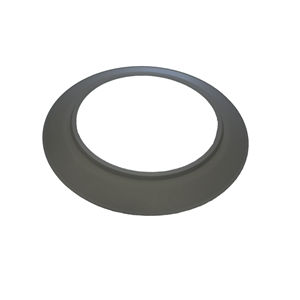
In the production process of radial tires, after the steel wire ring and apex rubber are laminated and rolled into shape, they need to be temporarily stored, transported, and stacked for the next step of molding. In this stage, it is often not the host equipment that truly determines whether the tire bead deforms, adheres to each other, or is accidentally grabbed by the robotic arm on the automation line. Instead, it is a seemingly inconspicuous injection molded plastic disc - the bead separator, commonly referred to as the PP tire bead spacer or apex disc in the industry.
1、 Structural design and matching logic
Bead Spacer is usually a disc-shaped injection molded part with a large diameter through-hole in the center for easy insertion of the robotic arm positioning pin or release of hot air. The disc edge is flanged upwards to form a receiving cavity, and the inner cavity side wall is equipped with 1-2 rings of circular protrusions (positioning ribs) to fit the outer contour arc of different specifications of tire bead steel wire. The bottom of the disc is generally designed with stepped sections and radial reinforcement ribs, which ensure interlocking positioning during stacking and suppress self bending deformation.
The curvature of its curved surface needs to be strictly customized according to the contour of the tire bead section - car tires, light truck tires, and all steel heavy-duty tires correspond to different arc heights and diameters (commonly compatible with 13 dddhhhto 22dddhhh wheel rim specifications), ensuring that the steel wire triangle rubber is evenly stressed and does not collapse locally after being placed.
2、 Material selection - why modified PP?
Traditional isolation has used fiberboard or metal trays, but the former absorbs moisture and deforms, causing debris to contaminate the adhesive material, while the latter is bulky and prone to scratching the surface of the triangular adhesive. The PP tire bead pad uses copolymer polypropylene (PP Copo) as the substrate and adds impact modifiers and a small amount of inorganic fillers. The main considerations are as follows:
Heat resistance and Vicat softening point control: Tire triangle rubber may undergo short-term heating (steam or oven) before subsequent vulcanization. The Vicat softening point of modified PP is usually controlled at 135-145 ℃, which can maintain rigid support at operating temperatures and prevent droplet contamination of the rubber material under extreme working conditions.
Impact toughness: The robotic arm of the automated production line can quickly grasp and stack stacks, and the impact strength of the cantilever beam gap needs to be high enough to prevent brittle cracking. Modified PP is superior to ordinary PS or ABS in this regard.
Low adhesion: The surface energy of PP is low, and it has weak affinity with uncured rubber compounds (especially tire bead adhesives containing aromatic hydrocarbon operating oils), which can effectively prevent the phenomenon of dddhhhadhesiondddhhh. When removing the tire bead, it is easy to demold without leaving any residue.
Lightweight and Cost: PP density is about 0.90g/cm ³, with a single piece weight of only a few hundred grams, greatly reducing workers' handling load. Moreover, the raw material cost is much lower than that of engineering plastics, making it suitable for large-scale circular consumption in tire factories.
3、 Actual role in the process flow
Isolation and anti sticking: Multiple layers of tire beads can be stacked for several hours to several days, and the tire bead partition blocks direct contact between the rubber materials to prevent irreversible adhesion or indentation caused by self weight compression.
Forming and shape preservation: After the triangular film is formed into a ring shape, there is a tendency for rebound. The arc-shaped inner cavity of the PP bead partition imposes constraints on it, maintaining roundness and cross-sectional shape, and reducing the calibration workload during subsequent forming.
Automation compatibility: The protruding platform at the bottom of the partition is matched with the central hole of the previous partition to achieve automatic stacking alignment; The robotic arm uses a vacuum suction cup to suction the partition or clamp the tire bead, and the fit is smooth without jamming.
Clean and friendly: The surface is smooth without fiber shedding, and can be cleaned and reused multiple times (usually with a lifespan of tens to hundreds of cycles, depending on the working conditions), meeting the management requirements of tire factory clean rooms.
4、 Attention to usage, maintenance, and selection
Specification matching: It is necessary to select the corresponding curved surface model of PP bead separator according to the diameter of the bead wire and the height of the triangular rubber. Incorrect use can cause local compression deformation of the bead, affecting the final tire uniformity.
Regular replacement: Long term repeated heating and bending can cause PP to gradually age, become white, brittle, or develop microcracks. If obvious warping or edge damage is found in the partition, it should be promptly eliminated to avoid scratching the rubber material.
Clean storage: It is recommended to rinse with deionized water and store in the shade to avoid prolonged direct sunlight exposure (UV stabilizers can be added for better weather resistance) to prevent accelerated photo oxidative aging.
As a severely underestimated auxiliary consumable in tire manufacturing, PP bead separators undertake the triple functions of shape preservation, isolation, and automation adaptation at an extremely low cost. For modern tire factories that pursue high uniformity and low scrap rates, standardized selection and scientific management of tire bead separators are equally important details to ensure the quality of finished products.
Changshu Yongchengsheng Hardware Products Co., Ltd. specializes in the production and sales of tire bead separators and PP tire bead pads. If you need them, please contact us at+86-13506249539; Contact email: ljd706627@gmail.com